Across the country communities are weighing these safety and environmental concerns and coming to the conclusion that wake surfing is not appropriate for their lakes or must be regulated. As present, there are just a few examples of meaningful statewide limits (Vermont) beyond the 200’/10’ rule espoused by the wake surfing industry. This is due in part to the fact that wake surfing is a relatively new sport and to be fair, it does not present the same risks to all lakes. Wake surfing is fine in most reservoirs in Western states where there is little shoreline infrastructure, or well offshore in the Great Lakes, for example. Many natural lakes, which are much smaller than reservoirs, are protected by local ordinances or are privately owned and regulated. Many local laws and ordinances and private homeowners’ association rules that prohibit wake surfing do exist - often in the form of “no wake” and “no towing sport” rules and zones. These local rules can be hard to find, but our supporters and volunteers have catalogued many of them:
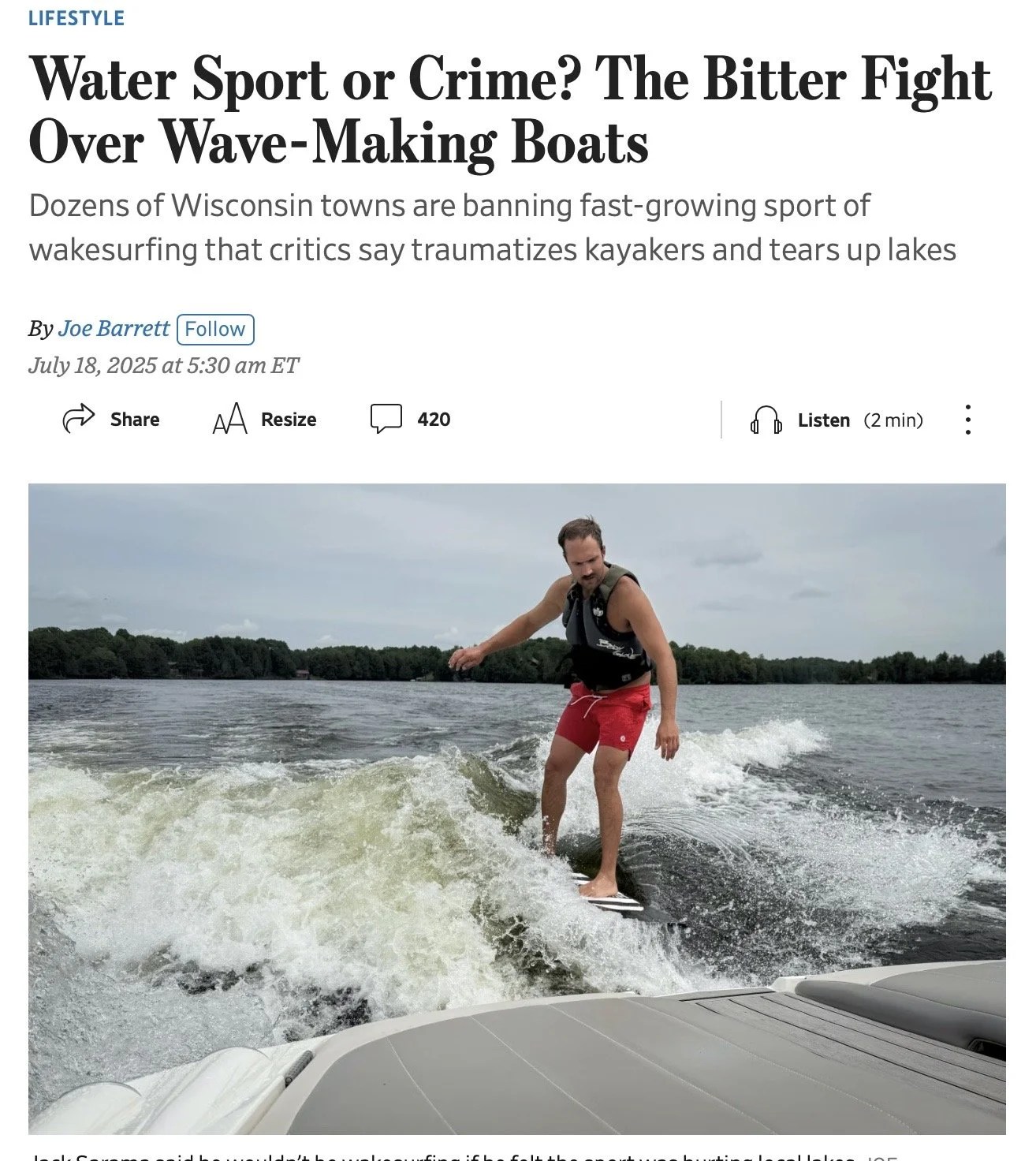
o In Wisconsin there are now 76 local ordinances banning wake surfing on more than 400 lakes. See www.LastWildernessAlliance.org.
o In Minnesota, the state legislature is considering banning wake surfing on a portion of the Mississippi River and strict statewide limits. The Clark County Board of Commissioners in Minnesota banned wake surfing on 760 acre Caribou Lake in 2024.
o Vermont recently enacted a law that limits wake surfing to designated zones in only its largest lakes. These zones must be at least 500’ from shore, with a depth of 20’ or more, at least 200’ wide, and of at least 60 contiguous acres. There is nowhere on Lake Waramaug that would qualify under these rules. Moreover, ten of those lake communities are now petitioning for even more restrictions. Led by Responsible Wakes for Vermont Lakes, advocates and 43 environmental and civic associations have come together to push for even tougher statewide restrictions on wake surfing. They seek at least a 700’ buffer from shore, in at least 30’ of water which must be at least 100 regularly-shaped contiguous acres.
Candlewood Lake in Ohio bans wake surfing. See Rule 4.2 https://candlewoodlake.us/wp-content/uploads/2021/07/Simplified-Tri-fold-Candlewood-Boating-rules-11-1-20.pdf.
Canyon Lake in California prohibits wake surfing.
Lake Tahoe, more than 150,000 acres and over 175’ deep, strictly enforces a 600’ no wake zone around its entire perimeter and in all of Emerald Bay, effectively banning wake surfing in those areas.
Wake surfing is banned in the Newburg Pool on the Willamette River in Oregon. A federal judge upheld this ban in December 2024.
Wake surfing is banned on Hideaway Lake in Texas. This privately owned lake actually won a federal lawsuit brought by a wake surfing homeowner challenging this ban in November 2024.
Across the nation: A trend. We participate in a group of nationwide advocates on this issue, and work with advocates seeking stricter statewide limits in places like Maine, Idaho, Michigan, Minnesota, and New Hampshire. Those states do not allow local control like we have in Connecticut, and getting meaningful legislation through state legislatures, especially with opposition from wake surfing industry advocates, is a multi-year process. But as wake surfing grows in popularity, so do community calls for appropriate regulation.
See the Wall Street Journal’s article :